


What is carbon fiber accumulator
Shanghai Siken Industries Inc.
Web: www.siken-inc.com
Email:info@siken-inc.com
A carbon fiber accumulator (also called a carbon fiber composite or composite hydraulic accumulator) is a lightweight version of a hydraulic accumulator. It uses carbon fiber-reinforced polymer (CFRP) composite materials—typically
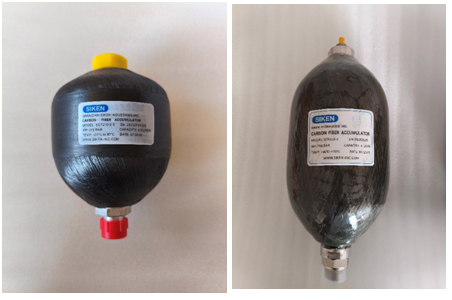
filament-wound carbon fiber with epoxy resin—for the pressure vessel (shell) instead of traditional all-steel construction. This dramatically reduces weight while maintaining high pressure ratings and energy storage capability.
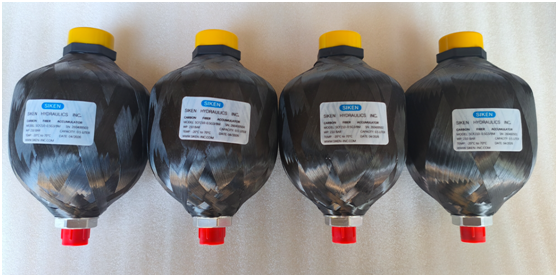
Construction and Types
These accumulators follow the same basic operating principles as conventional ones (precharged nitrogen gas separated from hydraulic fluid by a bladder, diaphragm, or piston), but the shell is optimized with composites:
• Carbon fiber-wrapped designs — A metal (steel or aluminum) or plastic liner is overwrapped with continuous carbon fiber filaments in specific patterns (hoop and helical windings) for strength. This is common for bladder-style units.
• Fully composite designs — Minimal or no load-bearing metal liner; the carbon fiber structure carries most or all of the pressure loads (hoop and axial). Examples include fully composite piston accumulators with composite shells and sometimes composite tie rods.
• Classification (similar to composite pressure vessels) — Often categorized as Type II (metal with hoop wrap), Type III (metal liner with full composite overwrap), or Type IV (plastic liner with full composite overwrap).
Internal components (bladder/diaphragm/piston, gas valve, fluid port with anti-extrusion features) remain similar to standard designs. End caps are frequently still metallic for connections and sealing.
How It Works
Operation is identical to conventional hydraulic accumulators:
• Nitrogen precharge compresses when system pressure forces fluid in, storing energy.
• Expanding gas releases fluid when system pressure drops.
The composite shell simply provides a much lighter pressure boundary with excellent strength and fatigue properties.
Key Advantages
• Major weight reduction — Often only 1/3 to 1/4 the weight of equivalent steel units (or even greater savings in fully composite designs; e.g., a 15 L unit dropping from ~90–130 kg steel to ~26 kg composite). This yields much higher specific energy (energy stored per unit mass) and specific power.
• High strength-to-weight ratio (carbon fiber composites can exceed steel by a large margin).
• Excellent fatigue resistance and corrosion resistance (especially with protective outer layers).
• Potential for higher pressures or larger sizes at manageable weights.
• Safety characteristics in some designs: gradual leakage rather than catastrophic burst when life is exceeded.
Typical pressure ratings reach 300–380 bar or higher (up to 690 bar / ~10,000 psi in some commercial ranges), with volumes from fractions of a liter to 50+ liters.
Limitations and Considerations
• Higher initial cost than standard steel accumulators.
• More specialized manufacturing (filament winding) and sometimes stricter handling/inspection needs.
• Impact resistance can require additional protective layers (e.g., glass fiber or Kevlar outer wraps).
• Temperature limits depend on the resin system (commonly –40 °C to +100 °C range).
• Repairability varies; some designs are serviceable, others less so.
Applications
Carbon fiber accumulators are used where weight is critical:
• Mobile and off-highway hydraulics
• Aerospace and aviation systems
• Offshore and marine (e.g., riser tensioning)
• High-performance vehicles, Formula Student electric vehicles, and motorsport
• Wind energy and other weight-sensitive industrial systems
• Any application benefiting from reduced mass for better efficiency, payload, or handling
In short, a carbon fiber accumulator delivers the energy storage, pressure regulation, shock absorption, and emergency power functions of traditional piston, bladder, or diaphragm accumulators, but in a far lighter package enabled by advanced composites. They represent a modern evolution of hydraulic accumulator technology for weight-critical environments.ial for performance and safety.