


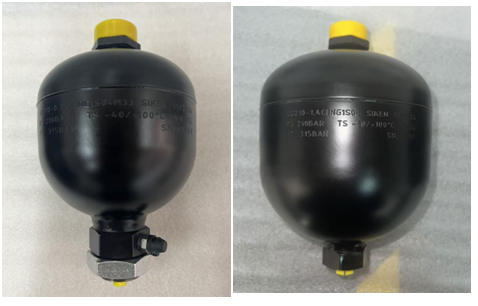
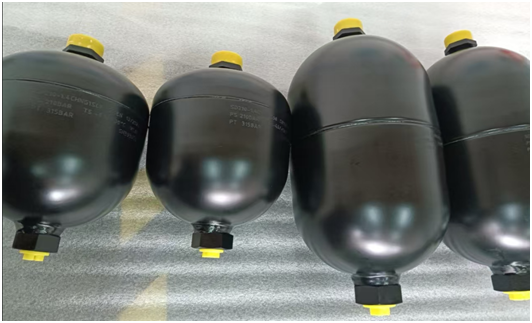
What is diaphragm accumulator
Shanghai Siken Industries Inc.
Web: www.siken-inc.com
Email:info@siken-inc.com
A piston accumulator is a type of hydraulic (hydropneumatic) energy storage device used in hydraulic systems. It stores energy by compressing a gas (typically dry nitrogen) separated from hydraulic fluid by a free-floating piston inside a cylindrical pressure vessel.
How It Works
• The accumulator has two chambers divided by a sealed, movable piston: one precharged with nitrogen gas and the other connected to the hydraulic fluid circuit.
• When system pressure rises above the gas precharge pressure, hydraulic fluid enters the fluid chamber and pushes the piston, compressing the gas and storing potential energy.
• When system pressure drops (e.g., due to demand from actuators), the compressed gas expands, driving the piston and forcing fluid back into the system.
This follows the principle that liquids are nearly incompressible while gases compress readily (related to Boyle’s law).
Main Functions
Piston accumulators serve several purposes in hydraulic systems:
• Energy storage — Store energy during low-demand periods so a smaller pump can handle peak loads.
• Pressure regulation and surge/pulsation dampening.
• Shock absorption (though bladder types often respond faster for high-frequency shocks).
• Leakage compensation and volume balancing.
• Emergency power or backup fluid supply.
Key Characteristics and Advantages
• Robust construction with a solid piston (often aluminum or steel with seals) creates a complete barrier between gas and fluid, reducing contamination risk and supporting long service life.
• Suitable for high pressures (often hundreds of bar / thousands of psi), large volumes (tens to hundreds of liters or more), high flow rates, and demanding conditions (wide temperature ranges, certain aggressive fluids).
• Easier seal replacement and maintenance compared to some other designs; can be installed in various orientations.
• Allow for piston-position sensing in some designs.
Comparison Notes
Compared to bladder (or diaphragm) accumulators, which use a flexible elastomer bladder:
• Piston types generally handle higher pressures, larger sizes, and more extreme conditions better.
• Bladder types typically offer faster response times and are often preferred for pure shock/pulsation absorption at moderate pressures.
• Choice depends on pressure, volume, response needs, fluid compatibility, contamination levels, and cost.
Piston accumulators are common in industrial, mobile, marine, oil & gas, construction, and heavy machinery hydraulic systems where reliable energy storage under tough conditions is required. Proper precharge pressure, sizing, and maintenance (including seal condition and nitrogen purity) are essential for performance and safety.ial for performance and safety.